1. Next-generation platforms for studying antidepressant action
According to the World Health Organization (WHO), depression is the fourth most common disease in the world and the leading cause of suicide. Experts predict that by 2030 it will be the most diagnosed disease in the world. The steadily increasing number of depressed patients, as well as the number of suicides, is an alarming factor. Nowadays, the main depression treatment options are psychotherapy combined with pharmacotherapy. Despite the available pharmacotherapy, it is a reluctant
treatment option due to the many side effects and lack of knowledge of the exact mechanisms of action and long-term impact. Current efficacy studies of new drugs are mainly based on conducting experiments with animals, which pose many research barriers, i.e. different physiological structure or high maintenance costs. Conducting experiments on an animal’s open brain is an additionally difficult process that requires specialized equipment and appropriate conditions, and raises many ethical
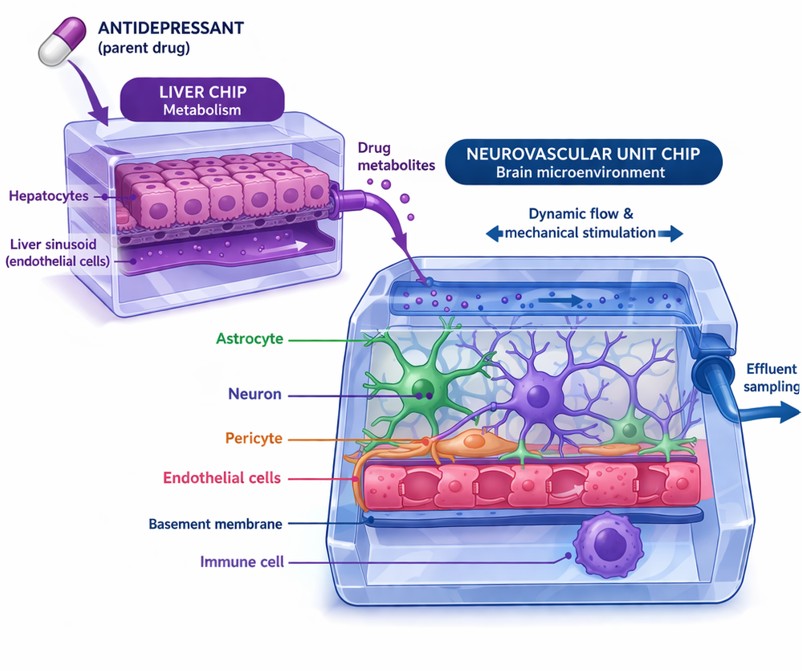
concerns. Traditional two-dimensional (2D) cultures, on the other hand, have a simplified design, making them lack important physiopathological signals. In addition, there is a lack of clearly defined bioanalytical methods that, without the unnecessary steps of collection and preparation of in vitro biological samples, allowed rapid and efficient evaluation of potential antidepressants. In view of the problems described above, we propose to use an Organ-on-Chip approach to develop procedures for bioanalytical evaluation of the effects of antidepressants on the neurovascular unit (NVU), considering liver metabolism.
People involved in the project:
Publications:
–