The liver is the largest internal organ of the human body and performs a wide range of essential physiological functions, including the metabolism of carbohydrates, proteins, and hormones, albumin synthesis, glycogen storage, detoxification of endogenous and exogenous compounds, bile production, and regulation of inflammatory responses. It also plays a central role in drug metabolism and biotransformation. Despite its remarkable regenerative capacity, the liver is highly susceptible to adverse drug reactions, which can lead to a loss of function. Drug-induced liver injury (DILI) remains one of the leading causes of drug attrition and market withdrawal, highlighting a critical challenge in pharmaceutical development.
Currently, animal models are the primary tools used in preclinical research; however, due to species-specific differences in drug metabolism and toxin sensitivity, they often fail to accurately replicate human-specific responses. As a result, in vitro models have emerged as a promising alternative. Although these systems are generally cost-effective and easy to implement, their predictive value is limited by their inability to fully recapitulate the complex architecture and microenvironment of human liver tissue. Conventional in vitro cultures often result in altered cell morphology, function, and gene expression. Moreover, they lack key physiological features such as appropriate extracellular matrix properties, fluid dynamics, and multicellular interactions, all of which play a crucial role in determining cell behavior and fate.
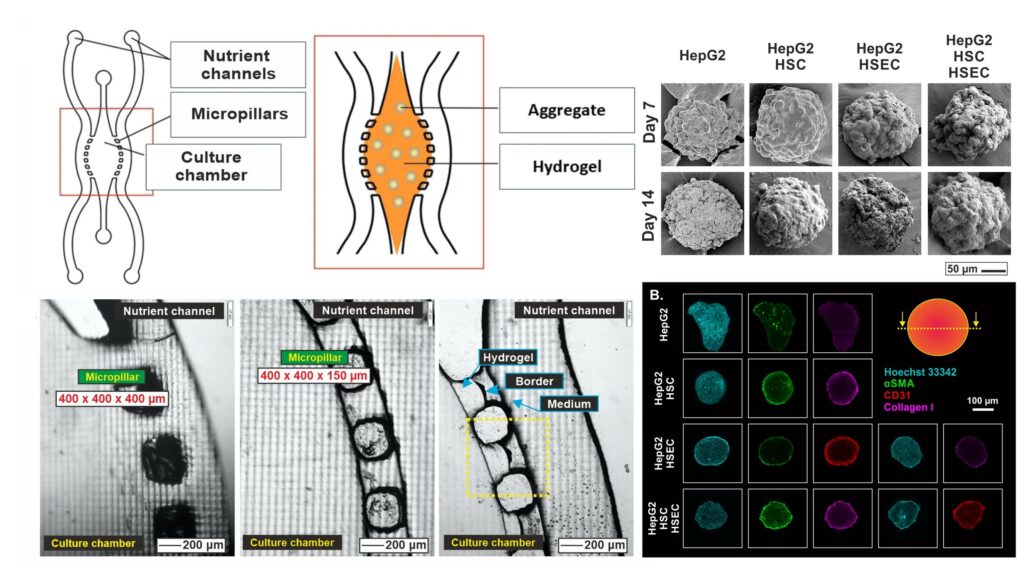
Therefore, we developed a high-throughput in vitro liver model that more accurately mimics in vivo conditions and can be applied in advanced drug screening, ultimately improving the efficiency and reliability of preclinical testing.
People involved in the project:
- Sonia Frojdenfal
- Agnieszka Żuchowska
Publications:
- Frojdenfal S., Zuchowska A. ; Advanced Liver-on-a-Chip Model for Evaluating Drug Metabolism and Hepatotoxicity; Biosensors 2024, 14(9):435.
- Zuchowska A. , Frojdenfal S., Trzaskowski M., Jastrzebska E.; Advanced three-dimensional in vitro liver models to study the activity of anticancer drugs; Biotechnology Journal 2024, 19(6):e2400159.